Tag Archives: Alfalfa and Timothy hay producers and exporters

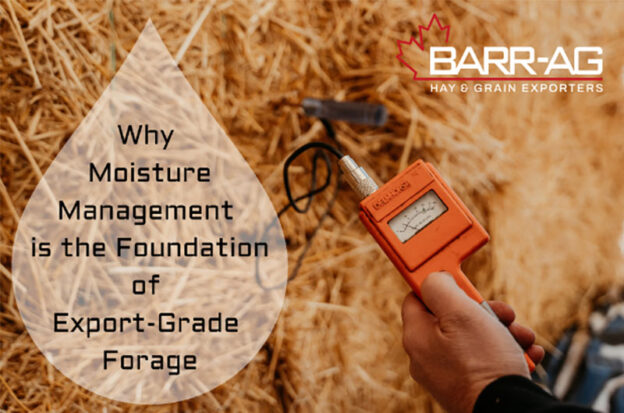
Why Moisture Management Is the Foundation of Export-Grade Forage

Why Moisture Management Is the Foundation of Export-Grade Forage

When evaluating forage quality, most buyers focus on protein, fiber, digestibility, and relative feed value. While these metrics are important, one critical factor often determines whether forage maintains its nutritional value from harvest to feeding: moisture management.

Proper moisture management is the foundation of producing and delivering export-grade forage. From the moment a crop is cut until it reaches the end user, moisture levels must be carefully monitored and controlled to prevent mold, heating, spoilage, and nutrient loss.

Whether the product is alfalfa, timothy, mixed hay, straw, or silage, managing moisture correctly helps preserve forage quality and protects the value of every bale.

Quality Starts in the Field

The moisture management process begins immediately after harvest.

Freshly cut forage contains a significant amount of moisture that must be reduced through proper curing before baling. The goal is to remove enough moisture to ensure safe storage while preserving leaves, colour, and nutritional value.

Baling forage too wet can create serious challenges:

  • Mold growth
  • Excessive heating
  • Nutrient degradation
  • Reduced palatability
  • Increased risk of spoilage during storage or transit

On the other hand, allowing forage to become excessively dry can increase leaf loss, particularly in alfalfa and other legume crops, resulting in reduced feed value.

Achieving the proper moisture balance is one of the most important decisions during harvest.

Why Moisture Matters for Nutritional Value

Many producers recognize that excessive moisture can cause mold, but fewer realize how significantly it can affect forage nutrition.

When moisture levels are too high, biological activity continues within the bale. This activity generates heat and can lead to nutrient losses over time.

Excessive heating may:

  • Reduce protein availability
  • Lower energy value
  • Decrease digestibility
  • Cause discoloration and quality deterioration

Forage that initially tested well can lose nutritional value if moisture is not properly managed during storage.

Maintaining appropriate moisture levels helps preserve the protein, energy, fibre characteristics, and overall feed quality that livestock producers depend on.

Preventing Mold and Heating

Mold and heating are among the most common causes of forage quality loss.

When excess moisture remains trapped within a bale, microorganisms can continue to grow and reproduce. As microbial activity increases, temperatures inside the bale rise.

This process can result in:

  • Mold development
  • Musty odours
  • Reduced feed intake
  • Increased waste
  • Loss of marketability

In severe cases, excessive heating can create fire risks within forage storage facilities.

Careful moisture management, combined with proper storage practices, significantly reduces these risks and helps maintain forage quality throughout the supply chain.

The Importance of Testing and Monitoring

Producing export-grade forage requires more than visual inspection.

Moisture testing provides valuable information throughout the harvest and storage process, helping ensure forage is baled and stored under appropriate conditions.

Regular testing allows producers and processors to:

  • Verify moisture levels before baling
  • Monitor stored inventory
  • Maintain consistent product quality
  • Reduce spoilage risk
  • Meet customer specifications

Accurate testing helps support quality assurance programs and provides confidence that forage will perform as expected upon delivery.

Storage Conditions Matter

Even properly cured forage can lose quality if storage conditions are inadequate.

Protecting forage from moisture after harvest is just as important as achieving the correct moisture level before baling.

Best practices include:

  • Storing forage in well-maintained facilities
  • Protecting inventory from precipitation and ground moisture
  • Promoting adequate airflow
  • Monitoring storage conditions regularly
  • Handling bales carefully to preserve integrity

Effective storage management helps maintain forage quality from harvest through shipment and feeding.

Moisture Management Across All Forage Types

Although moisture targets vary between products, moisture management is essential across all forage categories.

For example:

  • Alfalfa requires careful curing to preserve leaves and protein.
  • Grass hay benefits from proper drying to maintain colour and digestibility.
  • Straw must remain dry to prevent mold and storage losses.
  • Silage depends on controlled moisture levels to support proper fermentation and feed stability.

Regardless of forage type, moisture management directly influences product quality, consistency, and performance.

Building Confidence Through Quality Control

Forage buyers around the world depend on consistent quality and reliable performance. Achieving those standards starts long before a bale is loaded for shipment.

Proper curing, moisture testing, handling, and storage practices work together to preserve nutritional value and ensure forage arrives in the condition customers expect.

At Barr-Ag, we understand that moisture management is one of the most important factors in maintaining forage quality. Our focus on proper handling, testing, and storage helps ensure customers receive forage products that meet demanding domestic and international requirements.

To learn more about our forage programs or discuss your forage requirements, contact Barr-Ag today.

Canadian Forage

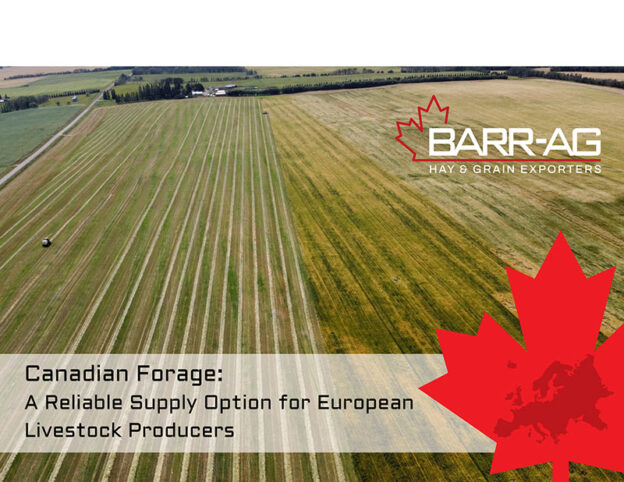
Why Buyers Are Turning to Canadian Forage

Around the world, many producers face challenges in sourcing consistent, high-quality forage. Shifting weather patterns, inconsistent harvesting practices, and contamination concerns can all compromise feed programs and animal performance. As operations look for suppliers they can trust year after year, many are turning to Canada for forage that is consistently clean, nutritionally stable, and backed by reliable export systems.

Ideal Growing Conditions

Canada’s forage regions benefit from long summer daylight, cool evenings, and clean soils with naturally balanced minerals. This combination supports slow, steady plant growth, stronger fiber structure, excellent leaf retention, and higher feed value. While many regions battle heat stress or rapid drying, Canada’s climate naturally preserves nutrients and promotes uniform quality.

Clean Production in the Field

Contamination is a concern for global buyers. Even small amounts of dust, weeds, or mold can compromise feed for dairy, livestock, or equine programs. Canadian producers implement strong field management that includes low weed pressure, moisture monitoring, responsible fertilization, and crop rotation. These practices result in cleaner, safer, and more dependable forage compared to regions with inconsistent field standards.

Processing and Storage That Preserve Feed Value

The difference between good forage and great forage is often determined after harvest. Canadian operations prioritize timely cutting based on nutrient stage, modern conditioning and baling technology, controlled storage to protect color and leaf structure, consistent moisture targets that reduce mold risk, and detailed load inspections before shipping. These practices apply to all forage types, including hay, silage, and straw.

Reliable Supply Chains

International buyers often face shipping delays, incomplete documentation, or inconsistent load quality. Canadian exporters are known for reliability, professionalism, and well-developed systems created specifically for global markets. These systems reduce the risk of delays, rejected loads, or supply chain disruptions.

Nutrition That Supports Performance

Canadian forage is trusted for its balanced protein-to-fiber ratio, strong digestibility, consistent dry matter, and dependable palatability. These qualities support improved milk production, healthier rumen function, better growth, and more stable feed behavior. For operations that rely on predictable outcomes, nutritional uniformity is essential.

Sustainability for Long-Term Supply

Buyers increasingly seek responsibly sourced feed. Many Canadian forage farms use soil conservation, water stewardship, smart fertilization, and diverse crop rotations to support long-term soil health and supply stability.

Why Canada Continues to Stand Out

Demand for clean, consistent, and predictable forage continues to rise. Buyers want transparency, reliability, and long-term partnerships rather than inconsistent or one-off shipments. Canada’s climate advantages, production standards, and export infrastructure position it as a dependable source of high-quality forage for operations worldwide.

Where Barr-Ag Ltd. Fits In

Barr-Ag Ltd. is Canada’s leading trusted forage producer and for over 20 years has been combining strong farming practices with proven international logistics. Offering Alfalfa, Timothy, Mixed Hay, Corn or Barley Silage, and Straw, Barr-Ag Ltd. supports every shipment with strict field management, careful processing and storage, accurate documentation, consistent load quality, and extensive export experience.

For operations seeking clean, reliable forage supported by a trusted Canadian export system, Barr-Ag Ltd. provides a proven solution.

Canadian Alfalfa Hay and Its Many Benefits

Canadian Alfalfa Hay

Over the past four decades, the Canadian Alfalfa processing industry has experienced tremendous growth. Today, it ranks as one of the top five largest exporters of Alfalfa in the world. Alberta-grown Alfalfa hay offers many benefits and advantages when compared to hay grown in other parts of the world. Canadian Alfalfa hay provides farmers with a consistently higher quality product, while also offering a more rapid harvesting time than many other types of hay.

Because of its high protein content, farmers across Canada and the United States use dehydrated Alfalfa hay as food for their livestock. The soil on the eastern slopes of the Canadian Rockies is rich in calcium and magnesium, which helps to produce a more robust, nutrient rich hay.

The clean air, long warm days, and cool nights in Canada ensure a vigorous production during the shorter growing season. Dry land alfalfa hay may be harvested up to twice per season, while irrigated alfalfa hay can be harvested up to three times each season. Because of it has a deep perennial root system, Alfalfa hay is a high water use forage crop. Although it optimally requires 540 to 680 mm of water per growing season in Alberta, the crop is relatively drought tolerant.

The long Canadian winters allow farmers to grow Alfalfa hay using more natural methods. This significantly reduces the need for pesticides and herbicides, as the cold temperatures effectively discourage pests and most weeds. The shorter growing season allows the land a greater resting period to recuperate. This recovery time helps eliminate the need for artificial fertilizers to coax more production, as is commonly necessary in areas with warmer climates.

This non-GMO crop also offers more stringent quality control guidelines. Instead of being graded by observation and smell the way Timothy hay is, Alfalfa hay is tested and graded by independent labs. Canadian Alfalfa hay promises a more consistent product, year after year.

Barr-Ag is a family-owned operation with a farm-to-farm business model. This allows them the unique ability to maintain much tighter control over the product they export. Barr-Ag’s farms and producers are strategically positioned near the eastern slopes of the Canadian Rocky Mountains where they are fortunate to have clean air, long warm days with cool nights, soil rich in calcium and magnesium and a pristine environment in which to grow their non-GMO alfalfa hay.

Growing 60% of all exported hay ensures that they can set high standards in place at each stage of their product, from planting to packaging. The remaining 40% of their stock is purchased from local growers with the same dedication to quality. Barr-Ag’s quality standards allow them to guarantee mold-free hay with less than 12% moisture content.

Contact Barr Ag to get more information on any or our crops including Alfalfa, Timothy, Mixed Hay, Canadian Grains and Pulse corps.

Alberta Alfalfa Hay

Medicago sativa is the Latin name for “the Queen of Forages”, alfalfa, the most popular and important forage legume grown in Canada. (Agriculture Canada, 1987) It owes its monarchic nickname to its many virtues and merits. Alberta Alfalfa Hay is considered to be one of the most palatable and nutritious of hays. Rich in protein, vitamins and minerals, alfalfa hay is one of the chief components of dairy cattle feed, as well as serving as an important dietary ration for milking goats, beef cattle, sheep and horses. Aside from the nutritional advantages that it provides for ruminants and a variety of equine species, alfalfa is also an indirect source for honey as bees gather a substantial amount of nectar from alfalfa flowers. (Alfalfa)  This high-yielding cultivar also has a great ability to improve soil quality and provide weed control for ensuing crops.

The plant itself is a bushy perennial legume which grows to a height of 60-100 cm. Its leaves consist of 3 leaflets which can range in shape from almost round to lanceolate. The stems are slender and may be either hollow or solid. Flowers grow in clusters of 10-20 and the florets are usually blue or purple, white or yellow, occasionally bronze and green and may be variegated with shades of blue and green. (Goplen, 1987) Seed pods are slightly downy and vary from kidney or sickle shaped to single, double or triple-coiled in appearance; however “the sickle pod has been almost eliminated by selection because it contains few seeds and shatters easily”. (Goplen et al., 1987, p.6)

The roots of the alfalfa plant are of four types: tap, branch, rhizomatious and creeping. The majority of roots probably penetrate most soils to a depth of about 2 m. (Fulkerson) Taproots typically penetrate “from 7 to 9 m, but roots have been observed 39 m deep in a mine beneath an alfalfa field”. (Sheaffer & Evers, 2007, p. 182) “Depending on the length of the growing season and maturity at harvest, alfalfa will have from 2 to 10 regrowth cycles”. (Sheaffer & Evers, 2007, p.182)

Canadian Alfalfa Hay

One of the distinctive characteristics of alfalfa is its ability to tap into the nitrogen supply in the air. It does this through an especially unique symbiotic relationship with a particular type of soil bacteria. These bacteria produce nodules on the root that convert nitrogen in the air into a form that is readily used by the plant- a process called “nitrogen fixation”. Soil acidity directly affects the growth and survival of these bacteria and can be a significant impediment to high alfalfa yields. Saline soil conditions also deter productivity because salinity adversely affects seed germination and also prevents roots from taking in water and essential nutrients.

At Barr-Ag, we take up to three cuts of the early maturing varieties of Alberta Alfalfa Hay from our irrigated farms. This alfalfa is sought after for its higher protein content. The later maturing variety is grown on our dryland properties and we harvest up to two cuts. All of our alfalfa hay is non-GMO.(See to the attached article: USDA to OK Genetically Modified Alfalfa )

Barr-Ag’s head office is located at 5837 Imperial Drive, Olds, Alberta, Canada, T4H 1G6. Please visit our website or call or write if you have any questions about our timothy hay, non-GMO alfalfa hay or any of our other products. We can be reached by telephone at: 403 507 8660 or by email at: [email protected] or [email protected]


References:
Fulkerson, R.S., Ontario Ministry of Agriculture and Food, Publication 59
Goplen, B.P, Baenziger, H., Bailey, L.D., Gross, A.T.H., Hanna, M.R., Michaud, R., Richards, K.W., Waddington, J., (1987) Agriculture Canada: Growing and Managing Alfalfa in Canada, Publication 1705/E
McKenzie, Ross H., (2005) Agri-Facts: Soil and Nutrient Management of Alfalfa
Sheaffer, Craig C., Evers, Gerald W., (2007) Forages: The Science of Grassland Agriculture
Alfalfa: http://science.howstuffworks.com/environmental/life/botany/alfalfa-info.htm
Forage: http://www4.agr.gc.ca/AAFC-AAC/display-afficher.do?id=1174594338500&lang=eng

Canadian Timothy Hay

Canada’s forage industry is booming as Asian markets continue to provide strong demand for one of the most commonly-grown forage grasses in Canada, timothy hay. Timothy is perfectly suited for growing in cooler, more temperate climates like that of the Alberta province. As far as forage grasses go, timothy hay is one of the more palatable options and preferred by most livestock.

Barr-Ag grows timothy hay in the cool and clean environment of the Canadian Rockies. The area near the eastern slopes where Barr-Ag grows its timothy is known for producing the sweetest timothy hay anywhere on the planet. It is thought that this is the result of the outstanding growing environment created by the perfect altitude and seasonal changes for timothy hay.

Timothy is a perennial bunchgrass that is well-adapted to climates like those found in Western Canada. The fertile farmland there is paired with long daylight hours and plentiful sun; because of the exceptional environment for the growing season, Barr-Ag is able to grow and produce timothy hay of unsurpassed quality. This is very important as increased incomes and better standards of living in many areas of the Middle East and Asia are resulting in higher demands for animal-based protein and dairy. The rapidly-expanding dairy and beef industries in Asian countries rely on Canadian timothy hay due to limited land area for growing forage in their own countries. In fact, Canadian timothy hay exports are growing nearly exponentially and currently account for more than $100 million in trade on a yearly basis.

Barr-Ag produces dry-land timothy hay that is harvested once every season, and irrigated timothy that can be harvested twice every season. Nearly all hay produced by Barr-Ag comes from their farms, with the balance coming from trusted producers. Additional hay is procured only from producers who have been carefully vetted to ensure their adherence to Barr-Ag’s strict growing protocols and standards of quality control.

Barr-Ag makes shipping easy through thorough accommodation of customer needs. All shipping and customs documents are prepared for buyers to help ensure that every delivery goes smoothly. Shipments to other continents, as well as those heading into the US, are treated with the utmost care and are routed through various ports to keep shipping time to a minimum. Various shipping options are offered by Barr-Ag, including cost and freight (CNF) and freight on board (FOB); container yard (CY) shipping is also available.

Contact Barr Ag to get more information on any or our crops including Alfalfa, Timothy, Mixed Hay, Canadian Grains and Pulse crops.