

Europe’s 2026 summer has been a difficult one for agriculture. Persistent heat and a lack of rainfall across large parts of Western and Central Europe have affected crops, grasslands and forage availability.
The European Commission’s Joint Research Centre reports that grassland productivity and pasture availability have declined significantly in several regions, raising concerns about fodder supply. The areas most affected include France, southern Germany, northern and central Italy, Austria, Czechia, Slovakia, Hungary and western Romania.
The impact is already being felt by livestock producers. In the Czech Republic, for example, drought has significantly reduced feed crop production, with some farmers reporting substantial shortages of haylage and other feed crops.
Situations like this highlight the importance of having access to additional sources of forage and animal feed.
Looking Beyond Local Forage Supply
Local production will always be at the centre of livestock agriculture. However, when weather conditions affect yields or when additional volumes are needed, international suppliers can provide another option.
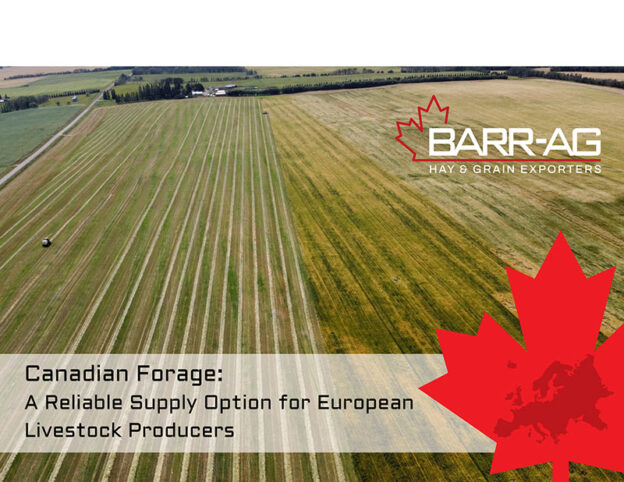
Canada is one of the world’s major agricultural-producing countries, with a large land base, established agricultural infrastructure and experience supplying forage products to international markets.
At Barr-Ag, we produce and export a broad range of Canadian forage and animal feed products, including hay, straw, dehydrated silage and pellets.
Our products include:
- Alfalfa Hay
- Timothy Hay
- Mixed Hay
- Wheat and Barley Straw
- Dehydrated Corn Silage
- Dehydrated Barley Silage
- Alfalfa Pellets
- Timothy Pellets
Different products serve different feeding requirements, giving customers the flexibility to source the type of forage that best fits their operation.
Alfalfa Hay
Alfalfa hay is an important forage for many dairy and livestock operations. It is valued for its nutritional content and is widely used in feeding programs around the world.
Canadian alfalfa is produced in a range of qualities and can be supplied in different bale formats depending on market and customer requirements.
Timothy Hay
Timothy hay is a widely used grass forage known for its fibre content and palatability.
It is used across a variety of livestock and animal feeding applications and is an established Canadian export product for international markets.
Mixed Hay
Mixed hay provides a versatile forage option consisting of a combination of grasses and legumes.
The exact composition can vary depending on the crop, growing conditions and production requirements, making mixed hay suitable for a variety of feeding programs.
Straw
Wheat and barley straw are used in both animal feeding and livestock bedding.
As a fibre source, straw can form part of a livestock ration, while its physical characteristics also make it a widely used bedding material for cattle, horses and other animals.
Dehydrated Corn Silage
Dehydrated corn silage is a different approach to supplying corn forage internationally.
Traditional corn silage is a high-moisture product and is generally produced and consumed relatively close to where it is grown. Its moisture content makes long-distance transportation and storage more challenging.
Through dehydration, we are able to produce a stable, low-moisture corn silage product that is suitable for storage and international transportation.
Our dehydrated corn silage typically contains approximately 8–10% moisture, with approximately 7–9% crude protein and 25–30% starch, although analysis can vary by crop and production year.
One of the biggest advantages of the dehydrated product is its year-round availability.
Rather than being limited to the traditional harvest and feeding season, dehydrated corn silage can be produced, stored and supplied throughout the year. This provides customers with a consistent product and a more predictable supply option.
Dehydrated Barley Silage
Dehydrated barley silage offers another forage option in a stable, low-moisture format.
Like dehydrated corn silage, it can be produced and supplied throughout the year, allowing customers to access a consistent product outside the traditional growing and harvest season.
The ability to store and transport dehydrated barley silage makes it particularly suitable for international markets where traditional fresh or high-moisture silage is difficult to move over long distances.
Alfalfa and Timothy Pellets
Pellets provide forage in a compact and easy-to-handle format.
Alfalfa pellets offer a convenient form of alfalfa forage for a variety of animal feeding applications, while timothy pellets provide a similar option for customers looking for a grass-based forage product.
Compared with traditional baled forage, pellets can offer advantages in handling, storage and transportation, depending on the customer’s feeding system and requirements.
Why Year-Round Availability Matters
The growing season naturally creates a degree of uncertainty for agricultural production.
When forage production is lower than expected, livestock producers and feed companies may need to source additional feed outside their usual market or earlier than planned.
This is one area where dehydrated forage products can offer an advantage.
Because dehydrated corn silage and dehydrated barley silage can be produced and stored for supply throughout the year, they are not dependent on immediate local harvest availability at the time a customer needs the product.
For international buyers, this also means having access to a forage product that is specifically suited to storage and containerized transportation.
From Canada to International Markets
International forage supply is about more than the product itself. Transportation and freight are an important part of the overall equation.
At Barr-Ag, our main international business is port-to-port container shipping. We work with freight providers and customers to arrange transportation from Canada to ports around the world.
Depending on the destination, we can also look at additional delivery options.
For selected destinations, we are able to offer delivery beyond the port and, in some cases, directly to the customer’s door. The availability and cost of these options depend on the destination, local transportation infrastructure and shipment requirements.
This allows us to look at different logistics solutions where appropriate, while our primary international business remains containerized port-to-port shipments.
A Broad Range of Canadian Forage Products
The current conditions in Europe are a reminder of how closely animal feed availability is connected to agricultural production and weather.
For livestock producers and feed companies, having relationships with suppliers in different agricultural regions can provide additional flexibility when circumstances change.
Canada offers significant agricultural production capacity and established export infrastructure, making it possible to supply a broad range of forage products to international markets.
At Barr-Ag, we combine several different product categories under one operation — from traditional baled forage and straw to pellets and dehydrated silage.
For customers looking for alfalfa hay, timothy hay, mixed hay, straw, pellets or dehydrated corn and barley silage, Canadian supply can provide another option when planning forage requirements.
Our dehydrated corn and barley silage add another dimension to that offering, with year-round production, consistent product format and suitability for international storage and transportation.
As European livestock producers and feed businesses navigate changing growing conditions, having access to reliable international forage sources can be an important part of planning ahead.
Barr-Ag supplies Canadian forage and animal feed products to international markets and works with customers to develop practical product and logistics solutions based on their destination and requirements.
Interested in learning more? Contact Barr-Ag to discuss our products, current availability and shipping options for your destination.