

Material consistency is becoming a growing challenge across both agriculture and industrial operations. Wood shavings, loose straw, and other traditional materials are often inconsistent from load to load, difficult to store and transport, and increasingly subject to availability and pricing pressure. As a result, more operations are looking at alternative materials that offer greater reliability without adding complexity.
What straw pellets are
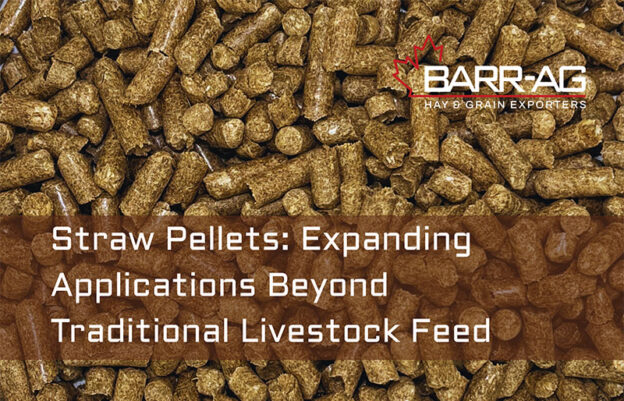
Straw pellets are made from agricultural straw that is ground and compressed into a dense, uniform format. This process creates a consistent fibre material that is easier to handle, store, and transport than loose straw. Their compact form reduces storage requirements and improves logistics, while their uniform size and density allow for more predictable performance across a range of applications.
Traditionally, straw pellets have been used within livestock systems as a fibre component in ruminant feed, as part of ration balancing, and in some cases as supplemental bedding. Their value in these roles comes from consistency—delivering a controlled input where variability in raw materials can create challenges in both feeding and management.
Expanding applications across agriculture and industry
More recently, straw pellets have moved well beyond their traditional role in livestock nutrition. In animal agriculture, they are increasingly used as bedding in cattle, equine, and poultry operations, as well as for smaller animals such as rabbits and guinea pigs. When exposed to moisture, the pellets break down and expand into a soft, absorbent layer, helping improve moisture control while maintaining a more uniform bedding surface. This can simplify handling, reduce variability, and create more consistent day-to-day conditions in barns and facilities.
Outside of livestock use, straw pellets are also being adopted in industrial and environmental settings. Their natural absorbency makes them suitable for spill control, moisture management, and general site use in sectors such as oilfield operations and facility maintenance. In environments where handling efficiency and cleanliness matter, a compact and consistent material offers practical advantages over loose alternatives.
They are also being used as a carbon input in composting systems, contributing to soil improvement once broken down, and in some regions as a biomass feedstock for renewable energy systems. At the same time, there is growing interest in agricultural by-products as part of broader sustainability and material substitution trends, particularly in packaging and industrial inputs.
Why consistency is driving adoption
A key reason for the shift toward pelletized straw is the need for consistency. Pelletizing changes the behaviour of the material by creating uniform size, density, and moisture characteristics. This improves predictability across applications, whether the end use is bedding, feed, or industrial absorbency.
The compact format also simplifies storage and transport, reducing volume requirements and improving handling efficiency. When exposed to moisture, controlled expansion increases coverage and usability, particularly in bedding and absorbent applications. For many operations, the value is not only in the material itself, but in the reliability of how it performs day to day.
Straw pellets compared to wood shavings
Straw pellets are increasingly being evaluated alongside traditional wood shavings, especially in bedding and absorbent uses. Wood shavings remain widely used, but their supply is closely tied to lumber production, which can lead to fluctuations in availability and pricing.
Straw pellets offer a more stable alternative due to the consistent availability of agricultural straw as a raw material. In addition to supply stability, pellets provide more uniform performance characteristics, particularly in moisture absorption and handling. Their compact nature also reduces storage space requirements and improves transport efficiency.
Rather than replacing wood shavings entirely, straw pellets are often being introduced where consistency, cost stability, and supply reliability are becoming more important operational factors.
Sustainable solutions and multi-purpose us
Within this evolving market, Barr-Ag is expanding its role with the introduction of a multi-purpose straw pellet program designed to support a range of applications. This includes livestock feed components, bedding for livestock and equine operations, and industrial uses such as oilpatch absorbents and moisture control materials.
A key focus of this expansion is providing a practical, agricultural-based alternative in markets where traditional materials like wood shavings are facing supply and cost pressures. Straw pellets offer a scalable and consistent option that can be produced and delivered in a controlled format.
Barr-Ag supplies straw pellets in multiple formats, including 20 kg bags, 700 kg totes, and bulk supply for larger operations and export markets. This flexibility supports use across different sectors, from on-farm applications to industrial and international demand.
As interest continues to grow in more reliable and efficient material solutions, straw pellets are increasingly being positioned as a multi-purpose input across agriculture, industry, and environmental applications. Their role continues to expand as operations prioritize consistency, handling efficiency, and supply stability.
For more information or to discuss your requirements, please contact us.