


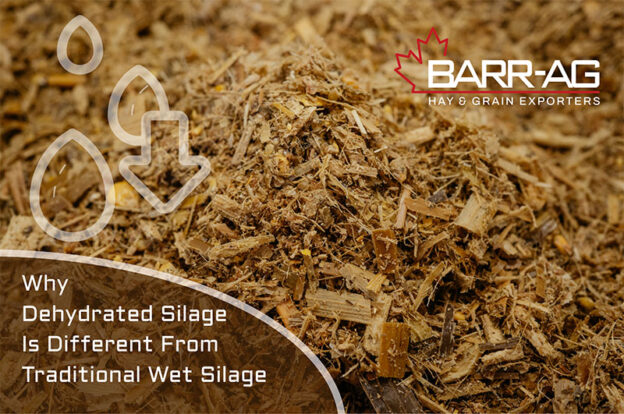
Many livestock farms produce their own wet silage and rely on it as an important part of their feeding program. But when additional forage is needed, transporting feed over long distances, or longer storage is required, dehydrated silage offers some important advantages.
At Barr-Ag, our Dehydrated Corn Silage and Dehydrated Barley Silage start as fermented silage and are then carefully dried to remove most of the moisture. The result is a concentrated, stable feed product that is easier to store and transport.
It Starts with Fermentation
Dehydrated silage is still fermented silage.
At Barr-Ag, our wet silage remains sealed for a minimum of 90 days before further processing.. For our dehydrated products, the fermented silage then goes through a controlled drying process to significantly reduce its moisture content.
The drying does not change the fact that the product originated as fermented silage — it simply creates a much lower-moisture form that is easier to handle and transport.
Slow Drying Makes a Difference
Drying silage is not simply about removing moisture as quickly as possible.
At Barr-Ag, we use a slow, controlled drying process to help protect the quality and characteristics of the product. Overheating can cause feed to “burn,” resulting in a burnt smell and changes to the product.
Our goal is to dry the silage carefully while maintaining its original smell and characteristics.
The result is a dry, stable product without the burnt or overheated aroma that can occur with overly aggressive drying.
More Dry Matter in Every Tonne
One of the most important differences between wet and dehydrated silage is moisture content.
Wet silage contains a significant amount of water. Dehydrated silage has had much of that water removed. Barr-Ag Dehydrated Corn Silage, for example, is typically produced at approximately 10% moisture.
This means that dehydrated silage is much more concentrated in dry matter.
For this reason, wet and dehydrated silage cannot be compared directly on a price-per-tonne basis. One tonne of dehydrated silage contains considerably more dry matter than one tonne of wet silage.
The same applies when comparing feeding rates. Nutritional value and inclusion rates should be considered on a dry-matter basis and supported by a current feed analysis.
Better for Long-Distance Transportation and Storage
Removing water also makes dehydrated silage much more practical to transport.
When wet silage is shipped long distances, a large portion of the weight being transported is water. Dehydration allows customers to transport more of the valuable dry matter instead.
This makes dehydrated silage particularly suitable for long-distance and international transportation, where shipping wet silage would be impractical or costly.
The low moisture content also provides a stable product that can be stored for longer periods when properly handled and stored.
A Supplement to Your Farm’s Own Silage
Dehydrated silage does not have to replace the silage a farm already produces.
Many farms have their own wet silage but use dehydrated silage to extend their forage supply when additional feed is needed.
For example, a producer may have less silage than expected due to lower yields, weather conditions, or increased feed requirements. Adding dehydrated silage can help supplement the existing forage supply without requiring a complete change in the feeding program.
It can also help maintain consistency in the ration. Rather than making a sudden change to a completely different forage when farm-produced silage becomes limited, dehydrated silage can be incorporated as an additional, consistent feed ingredient.
This can be especially useful when maintaining a stable feeding program is important.
A Practical Form of Fermented Silage
Dehydrated silage offers a different way to use fermented forage.
It combines the characteristics of a fermented feed product with the practical advantages of low moisture, concentrated dry matter, easier storage, and more efficient transportation.
At Barr-Ag, our focus is on producing a consistent product through careful fermentation and slow, controlled drying — while maintaining the original characteristics of the silage.
For livestock producers, dehydrated silage can be a valuable addition to an existing feeding program, whether the goal is to extend home-grown forage, maintain consistency, or source forage from a different growing region.
It is not about replacing wet silage. It is about making fermented forage more flexible.