


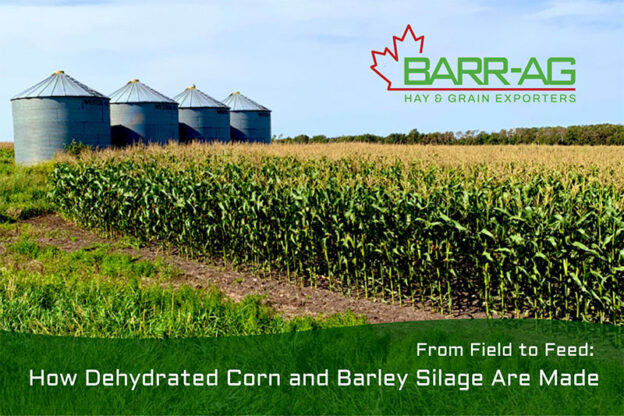
When people think about livestock feed, they often picture hay bales neatly stacked in a field. While hay remains an essential forage source, silage plays an equally important role in providing consistent, high-quality nutrition for beef and dairy operations.
At Barr-Ag, we take that one step further by producing dehydrated corn silage and dehydrated barley silage, combining traditional silage production with modern processing technology to create a stable, easy-to-handle forage product.
But how does silage go from a growing crop to a premium feed? Let’s take a closer look.
Step 1: Planting the Crop
The process begins long before harvest.
Corn and barley varieties are carefully selected based on their suitability for silage production, considering factors such as yield, digestibility, and nutritional value. Throughout the growing season, weather, soil conditions, and crop management all influence the final quality of the forage.
Healthy crops are the foundation of quality feed.
Step 2: Harvesting at the Right Time
Timing is everything when producing silage.
Unlike grain crops, silage is harvested as the entire plant. The goal is to capture the crop when it has reached the ideal balance between moisture, starch development, fibre digestibility, and overall nutritional value.
Harvesting too early can reduce energy content, while harvesting too late can make the crop more difficult to pack and ferment properly.
Experienced growers monitor crop maturity closely to ensure the best possible harvest window.
Step 3: Chopping the Crop
Once the crop reaches its ideal maturity, specialized forage harvesters chop the entire plant into small, uniform pieces.
The correct chop length helps improve packing density while creating a consistent feed that is easier for livestock to consume and digest.
Uniform particle size is also essential for successful fermentation.
Step 4: Building and Packing the Silage Pit
After chopping, the silage is transported to a bunker or pit where it is packed in thin layers using heavy equipment.
Proper packing removes oxygen from the forage, creating the anaerobic environment needed for fermentation.
This step is one of the most important in the entire process. Poor packing can lead to spoilage, heating, and nutrient loss.
Once the pit is filled, it is carefully sealed with plastic to keep oxygen out and protect the forage during storage.
Step 5: The Fermentation Process
Now nature takes over.
During fermentation, naturally occurring lactic acid bacteria convert plant sugars into organic acids. As the pH drops, the forage becomes stable and well preserved.
At Barr-Ag, our silage remains sealed for a minimum of 90 days, allowing fermentation to fully stabilize before it is opened for feeding or further processing.
This preservation process helps maintain valuable nutrients while reducing spoilage.
Step 6: Processing and Dehydration
Once fermentation is complete, Barr-Ag processes the silage using specialized dehydration equipment.
Removing moisture creates a product that is easier to transport, store, and handle while helping preserve the nutritional value s of the original crop.
The dehydration process also provides greater consistency from bale to bale and significantly extends shelf life compared to conventional silage.
Step 7: Baling and Storage
After dehydration, the silage is compressed into high-density bales for efficient storage and transportation.
The finished product is clean, uniform, and convenient to handle, whether it’s being delivered to local producers or shipped to customers around the world.
Consistent packaging also helps simplify inventory management and feeding operations.
Why Dehydrated Silage?
Traditional silage has long been valued for its excellent nutritional profile, but dehydrated silage offers additional advantages for many operations.
Some of the benefits include:
● Longer shelf life
● Easier transportation over long distances
● Reduced storage concerns
● Consistent moisture levels
● Convenient handling and feeding
● Excellent option for export markets
These advantages make dehydrated corn and barley silage an attractive solution for producers looking for reliable forage throughout the year.
Quality Starts in the Field
Producing premium silage isn’t the result of a single step—it’s the outcome of careful management throughout the entire process.
From selecting the right crop and harvesting at the optimal stage to proper fermentation, dehydration, and packaging, every stage contributes to the quality of the final product.
At Barr-Ag, we’re committed to producing forage products that deliver consistency, reliability, and nutritional value for livestock producers both across North America and around the world.
Whether you’re feeding beef cattle, dairy cows, or other livestock, understanding how silage is produced helps explain why quality begins long before the feed reaches the bunk.