

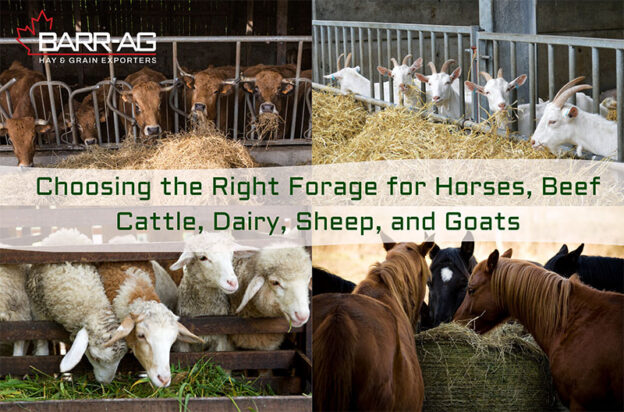
Understanding the nutritional needs of different livestock is the first step toward choosing the right forage.
Forage is one of the most important components of livestock nutrition. Whether feeding horses, beef cattle, dairy cows, sheep, or goats, selecting the right hay or forage product can have a significant impact on animal health, performance, productivity, and overall feeding costs.
However, not all animals have the same nutritional requirements. A forage that works well for a high-producing dairy cow may be too rich for an easy-keeping horse, while the needs of a growing beef animal differ considerably from those of a mature sheep or goat.
Understanding the differences between forage types and their nutritional characteristics helps producers make informed feeding decisions.
Let’s take a closer look at what to consider when choosing forage for different types of livestock.
1. Horses: Balancing Fibre, Energy, and Protein
Horses rely on forage as the foundation of their diet. Good-quality hay provides essential fibre for digestive health while supplying energy, protein, vitamins, and minerals.
The ideal forage depends on the horse’s age, activity level, body condition, and overall health.
Timothy Hay
Timothy is a popular choice for horses, particularly those with moderate or lower energy requirements. It provides good fibre content and generally has a moderate protein and energy profile.
It is commonly used for:
- Adult horses in maintenance or light work.
- Horses that tend to gain weight easily.
- Feeding programs where a consistent source of grass forage is preferred.
Alfalfa Hay
Alfalfa is a legume forage that typically contains higher levels of protein, energy, and calcium than grass hay. It can be particularly beneficial for horses with increased nutritional requirements.
It is often considered for:
- Performance and working horses.
- Growing horses and lactating mares.
- Horses requiring additional calories or protein.
- Horses that need encouragement to maintain feed intake.
Mixed Hay
Grass and alfalfa blends offer a middle ground between the two forage types. They combine the fibre characteristics of grass hay with some of the additional protein and energy supplied by alfalfa.
For many horses, mixed hay can be a practical option for balancing nutritional requirements without relying exclusively on a high-energy legume forage.
Important consideration: Horses should receive clean, well-cured forage that is free from mold, excessive dust, and foreign material. Horses with metabolic conditions or special dietary requirements may also need forage testing to evaluate sugar and starch levels.
2. Beef Cattle: Matching Forage to Production Stage
For beef cattle, forage is an essential source of energy and protein, particularly during the winter feeding season when pasture is unavailable.
The right forage depends largely on the production stage of the animal. Mature cows in early pregnancy have different nutritional requirements than cows approaching calving, lactating cows, or growing feeder cattle.
Grass Hay
Grass hay can be an economical foundation for beef cattle feeding programs, particularly for mature cows with moderate nutritional requirements.
Depending on its quality and maturity at harvest, grass hay can provide sufficient energy and fibre for animals in maintenance.
Alfalfa and Grass-Alfalfa Mixes
Alfalfa provides higher protein and energy levels and can help meet the increased nutritional demands of cattle during late pregnancy, lactation, or growth.
Grass-alfalfa blends can also provide a balanced forage option for different stages of production.
Cereal Forages and Straw
Barley, oat, and wheat forages can be used in beef cattle feeding programs. Cereal straw, in particular, is often incorporated into winter rations as a fibre source.
However, straw is considerably lower in protein and energy than good-quality hay. It should therefore be combined with appropriate energy, protein, and mineral sources to meet the animal’s nutritional requirements.
Important consideration: Forage testing is particularly valuable in beef production. It allows producers to allocate higher-quality hay to animals with greater nutritional needs while using lower-quality forage for mature animals in maintenance, helping optimize feed resources and overall costs.
3. Dairy Cattle: Prioritizing Digestibility and Nutritional Value
Dairy cattle have some of the highest nutritional requirements of all livestock, particularly during early lactation when milk production places significant demands on the animal.
Forage quality directly influences feed intake, rumen function, milk production, and overall herd performance.
Alfalfa Hay
Alfalfa is widely used in dairy feeding programs because of its relatively high protein, energy, and calcium content.
High-quality alfalfa can help support:
- Milk production.
- Protein requirements.
- Dry matter intake.
- Overall ration quality.
Grass and Mixed Hay
Grass hay and grass-alfalfa blends can complement alfalfa in dairy rations. They contribute fibre and can help balance the overall nutritional composition of the diet.
Dehydrated Forages and Silage
Processed forage products, including dehydrated alfalfa pellets and dehydrated corn silage, can provide additional flexibility in dairy feeding programs.
Dehydrated forages offer a concentrated and convenient way to incorporate forage nutrients into a ration. Dehydrated corn silage can contribute energy and starch, depending on its nutritional composition.
These products can be particularly useful when producers want to diversify their forage sources or supplement existing feeding programs. Important consideration: Dairy rations need to balance energy, protein, fibre, and effective fibre. The nutritional value of the forage, not simply the amount fed, plays an important role in maintaining milk production and rumen health.
4. Sheep: Quality Forage for Growth and Reproduction
Sheep are ruminants that rely heavily on forage for their nutritional needs. However, their requirements vary considerably depending on whether they are growing, maintaining body condition, pregnant, or producing milk.
Grass Hay
Good-quality grass hay can provide a suitable foundation for mature sheep during maintenance periods. It supplies fibre and can contribute to daily energy requirements.
Alfalfa Hay
Alfalfa is a valuable forage option for sheep with higher nutritional demands. Its higher protein, energy, and calcium content can support growth, pregnancy, and lactation.
It can be particularly useful for:
- Growing lambs.
- Pregnant ewes, especially during late gestation.
- Lactating ewes.
- Animals requiring additional nutritional support.
Mixed Hay
Grass-alfalfa blends can provide a practical balance of fibre and nutrients for different groups within a flock.
Important consideration: Sheep are particularly sensitive to excessive copper intake. Mineral supplementation must be specifically formulated for sheep, and the complete diet should be considered when selecting forage and additional feed products.
5. Goats: Forage That Supports Their Unique Feeding Behaviour
Although goats and sheep are both small ruminants, their feeding behaviour and nutritional requirements are not identical.
Goats are natural browsers and often prefer leaves, shrubs, and more varied plant material. Nevertheless, good-quality hay and other forages remain important components of their diet, particularly when pasture and browsing opportunities are limited.
Alfalfa Hay
Alfalfa is a particularly useful forage for goats with higher nutritional requirements, including growing kids, pregnant does, and dairy goats.
Its protein and energy content can help support growth, reproduction, and milk production.
Grass Hay
Grass hay provides fibre and can be a suitable option for mature goats with moderate nutritional requirements.
Mixed Hay
Grass-alfalfa blends offer another practical feeding option, providing a combination of fibre, protein, and energy.
Important consideration: Dairy goats and growing animals generally require more nutrient-dense forage than mature animals in maintenance. Mineral supplementation should also be species-specific. Goats require copper in their diets, while sheep are much more susceptible to copper toxicity.
6. What to Look for When Choosing Forage
Regardless of the animal species, several factors should be considered when evaluating forage quality.
1. Nutritional Composition
Crude protein, fibre, energy, moisture, and mineral content all contribute to the nutritional value of forage. The ideal balance depends on the animal’s requirements.
2. Stage of Harvest
The maturity of the plant at harvest has a significant influence on forage quality. Generally, younger plants contain more protein and energy and are more digestible, while more mature plants contain higher fibre levels and lower nutrient concentrations.
3. Cleanliness and Appearance
Good-quality forage should be properly harvested, cured, and stored. Look for:
- Fresh, natural colour.
- A clean, pleasant smell.
- Minimal dust and foreign material.
- No visible mold or signs of spoilage.
4. Consistency and Storage
Consistent forage quality is important for maintaining a reliable feeding program. Proper drying, handling, packaging, and storage help preserve nutritional value and reduce spoilage.
5. Forage Testing
Visual appearance alone cannot determine the complete nutritional composition of hay. Laboratory analysis provides valuable information about protein, fibre, energy, and other nutritional components, helping producers make better feeding decisions.
7. The Right Forage Makes a Difference
There is no single forage that is ideal for every animal. Alfalfa, timothy, mixed hay, cereal forages, and processed forage products each have their own characteristics and potential applications.
The key is to match the forage to the animal’s nutritional requirements, production stage, and feeding program.
A horse in light work may benefit from a grass-based diet, while a lactating dairy cow may require highly digestible, nutrient-dense forage. Beef cattle may benefit from different forage combinations throughout the production cycle, and sheep and goats require feeding programs that account for their specific nutritional needs.
By understanding these differences, livestock producers can make more informed decisions, support animal health, and get the most value from their feed resources.
At Barr-Ag, we understand that quality forage is an important part of successful livestock production. We process and supply a range of forage products, including alfalfa, timothy, mixed hay, cereal straw, dehydrated silage, and forage pellets.
Whether you are looking for traditional baled forage or processed forage products, choosing the right product starts with understanding your animals’ needs.
Have questions about our forage products or which options may suit your feeding program? Contact the Barr-Ag team. We would be happy to help.